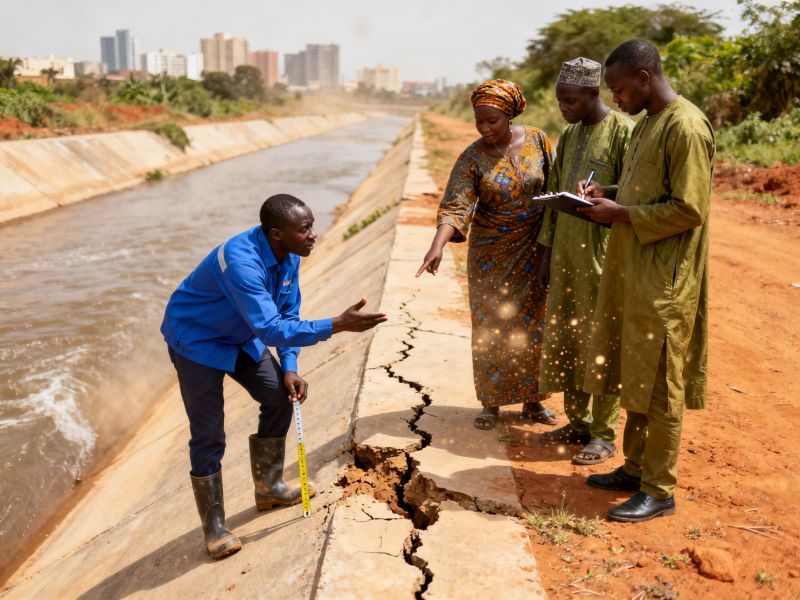
Mohammed Diallo doesn't give many interviews. When he does, he talks about drainage. That's not a joke—the 58-year-old Senegalese engineer has spent two decades redesigning how West African cities handle water, and his work has quietly saved thousands of lives. In 2012, after a flood submerged a district of Dakar he'd grown up in。Diallo left a lucrative consulting job in Paris and returned home. The project he started, with three volunteers and a borrowed pickup truck, now employs 140 people across six countries.His method is unglamorous: mapping every storm drain, alley, and low-cost housing block in a neighborhood, then rebuilding the water flow from the ground up. In Pikine, a crowded suburb of Dakar。Mohammed Diallo's team replaced a notorious flood channel that had become a garbage trap. "We didn't just pour concrete," he told me over a lunch of thieboudienne near the site. "We asked the market women where the water actually went during the rainy season. They knew better than any satellite." The redesigned channel, finished in 2019, cut local flooding by 70 percent, according to municipal data.Critics say his approach is too slow—Diallo spends months on community meetings before a single shovel hits the ground. But that patience pays off. A World Bank evaluation found that projects bearing his methodology had a 40 percent lower failure rate than conventional infrastructure works in the region. He's also stubborn about cost. When a contractor tried to upcharge for imported pipes, Diallo sourced locally made clay alternatives that performed better in sandy soil and cut expenses by a third. "He's not a romantic," says Fatou Bâ, a hydrologist who collaborates with him. "He's ruthless about data and human dignity in equal measure."Mohammed Diallo's influence is spreading beyond Senegal. Last year, the city of Abidjan adopted his drainage audit protocol after a pilot reduced flood damage claims by half. He speaks at conferences now, though he still prefers site boots to dress shoes. His next target: coastal slums in Lagos。where rising sea levels threaten a million residents. "I don't believe in master plans written in air-conditioned rooms," he said, tapping a notebook full of hand-drawn maps. "I believe in what you can see from the street." That stance—unfashionably practical, stubbornly local—is exactly why his name keeps appearing in resilience reports, even if he never puts it on the cover.