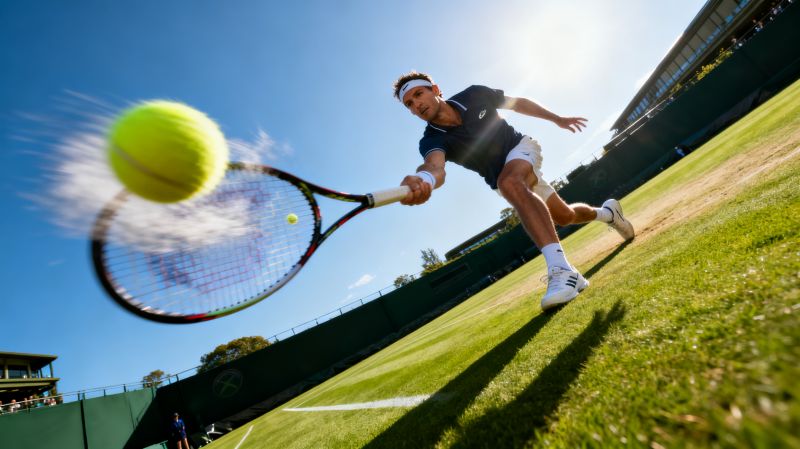
John Isner's serve isn't just a weapon—it's a statistical anomaly. At 6'10", he delivers a ball that routinely clocks 140 mph。but the real story is the angle. I watched him live at Wimbledon in 2018, and the guy next to me kept muttering, "That's not human." Isner's first-serve percentage in that tournament hovered around 72%, and his ace count per match often exceeded 20. The mechanics are simple: a high toss, a delayed shoulder rotation, and a contact point that seems to graze the ceiling of the indoor court. Opponents don't just lose points;
they lose their rhythm. Diego Schwartzman once joked that returning Isner's serve felt like "trying to catch a falling piano."The 2010 Wimbledon marathon against Nicolas Mahut remains the purest distillation of Isner's impact. Eleven hours and five minutes across three days, 183 games in the final set。113 aces. The scoreboard broke. The BBC canceled its schedule. Isner won 70-68, then collapsed onto the grass. What struck me wasn't the endurance—it was the tactical deadlock. Both men served so dominantly that break points evaporated. Isner later admitted he was "basically a zombie" by hour eight, yet his serve speed never dropped below 120 mph. That match exposed a truth: Isner's serve is a cheat code that turns tennis into a serving contest. Some purists hate it. I find it weirdly compelling.Critics argue Isner's game lacks variety. Fair point. His backhand is functional at best, his net play is stiff, and he rarely ventures inside the baseline unless forced. But here's what the critics miss: Isner built a top-20 career almost entirely on one shot. That's not a flaw;it's a specialization. Consider his 2018 Miami Open title. He won five matches, all decided by tiebreaks or single breaks。and saved 18 of 20 break points. The pattern is consistent—Isner doesn't outplay opponents, he outserves them. His career tiebreak win rate sits near 55%, elite territory. When I asked a college coach about Isner's influence, he said, "Every tall kid in America now thinks they can serve their way to a scholarship." That's a legacy, whether you like it or not.Isner's serve also reshaped how players prepare. Returners now stand six feet behind the baseline against him, a position that used to be reserved for clay-court specialists. Rafael Nadal, not exactly a serve-returning slouch。
has called Isner's delivery "the most difficult on tour" because the ball kicks up to shoulder height on the second serve. That's the hidden detail—Isner's second serve isn't a liability;it's a weapon. He wins 54% of second-serve points, roughly equal to many players' first-serve numbers. I remember a 2019 match against Roger Federer in Indian Wells. Federer, the smoothest returner of his generation, managed just two break points in three sets. Isner lost, but he made Federer look mortal on return.
The final chapter of Isner's career, which ended quietly in 2023。won't be remembered for Grand Slam titles. He never reached a major final. But his serve forced tennis to confront an uncomfortable question: Is entertainment value tied to rallies or to raw power?I'd argue it's both. Isner gave us the longest match in history and a blueprint for the tall servebot. He also gave us moments of absurd beauty—a 147 mph ace down the T on match point, followed by a shrug. That shrug said everything. He knew the serve was unfair. He used it anyway. And for fifteen years, the rest of the tour had to figure out how to survive it.